H3 & Hypermedia
Here is a rundown of what happened in the last month with respect to H3 and generative video:
- July 31: MiniMax launches a new video model endpoint for H3. It is benchmarking well.
- August 2: MiniMax releases the open weights model.
- August 26: Fal releases H3 Max.
The Threshold: Generation Time < Playback Time
The critical breakthrough with H3 Max is this:
Length of time to generate a video < Length of the generated video
If you can generate a 5-second video in 3 seconds, the buffer never runs dry. That simple math unlocks an entirely new class of applications:
- Infinite scroll applications without any pre-recorded creator catalog.
- Video games running with no traditional game engine.
- Choose-your-own-adventure interactive story applications.
- AI-generated QVC and automated 24/7 interactive shopping broadcasts.
- Audience-controlled streams where chat messages, poll votes, or controller buttons decide what the screen renders next.
This is a landmark moment. It reminds me of Dadabots and infinite music looping a few years ago, when neural generation outran real-time audio playback to produce an endless streaming endpoint.
Earlier demos, like the Happy Horse demo a few months ago, pulled off real-time video generation only by running on a massive, private GPU cluster. H3 Max is different: it is an accessible public API endpoint that returns 5-to-15 second clips in under playback duration, with zero local inference hardware required.
The Core Loop and Universal Chaining
Every one of these applications runs on the exact same underlying engine loop:
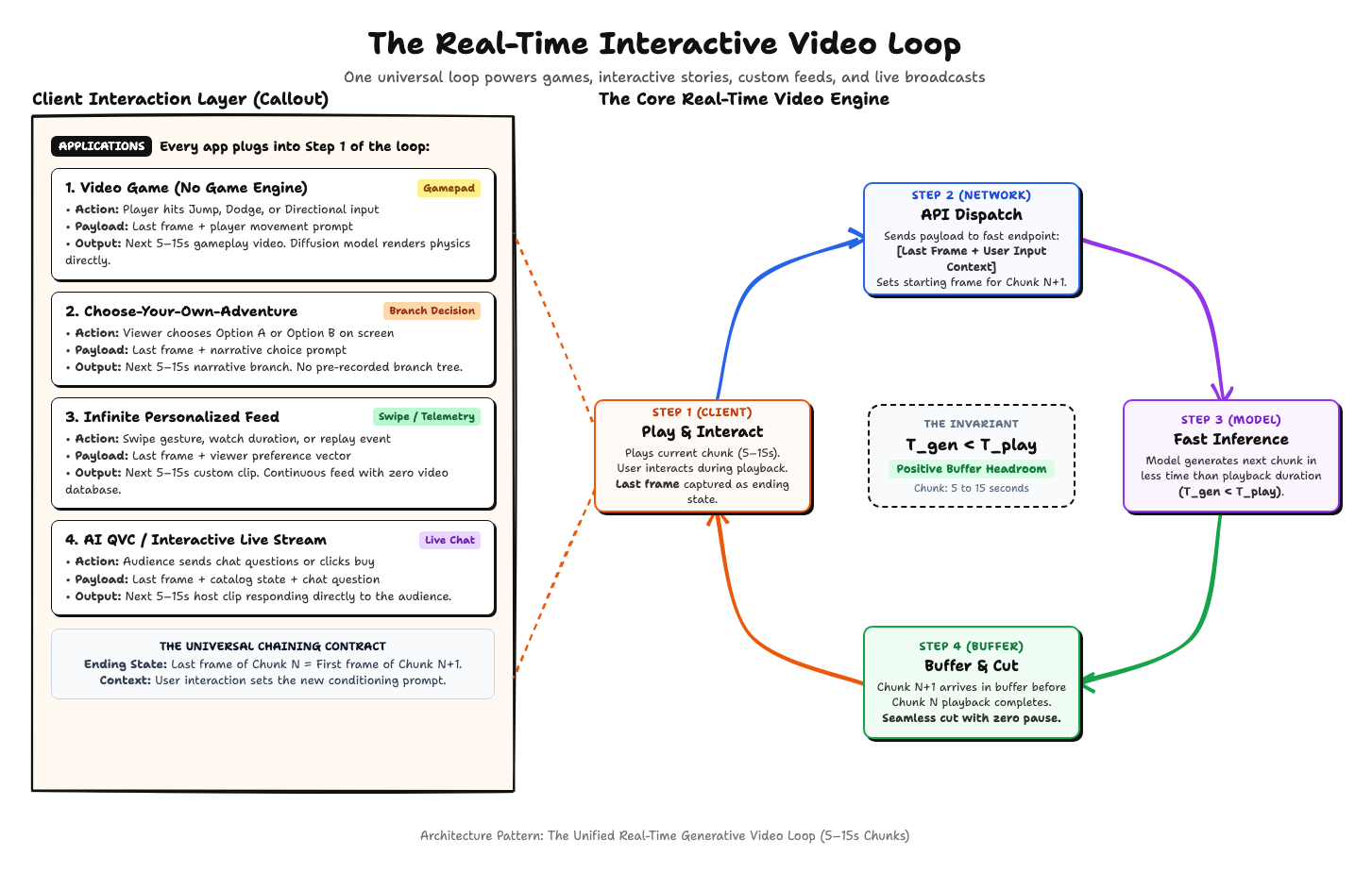
The Universal Chaining Contract
The API endpoint does not care whether the client is a game controller or a Twitch chat:
- Step 1 (Play & Interact): The screen plays the current video chunk (typically 5 to 15 seconds). While it plays, the user or audience submits an input.
- Step 2 (API Dispatch): The client captures the ending state—the final frame of the playing video—and dispatches it along with the user input prompt to the endpoint.
- Step 3 (Fast Inference): The model completes the next chunk in less time than playback duration (T_gen < T_play).
- Step 4 (Buffer & Transition): The next chunk arrives in the buffer before the current chunk ends. The player cuts seamlessly with zero buffering pause.
The Builder Matrix: Why Endpoints Matter
Without an endpoint, builders had to run on bare-metal GPU clusters. That infrastructure bottleneck drastically limited the number of developers experimenting in the space.
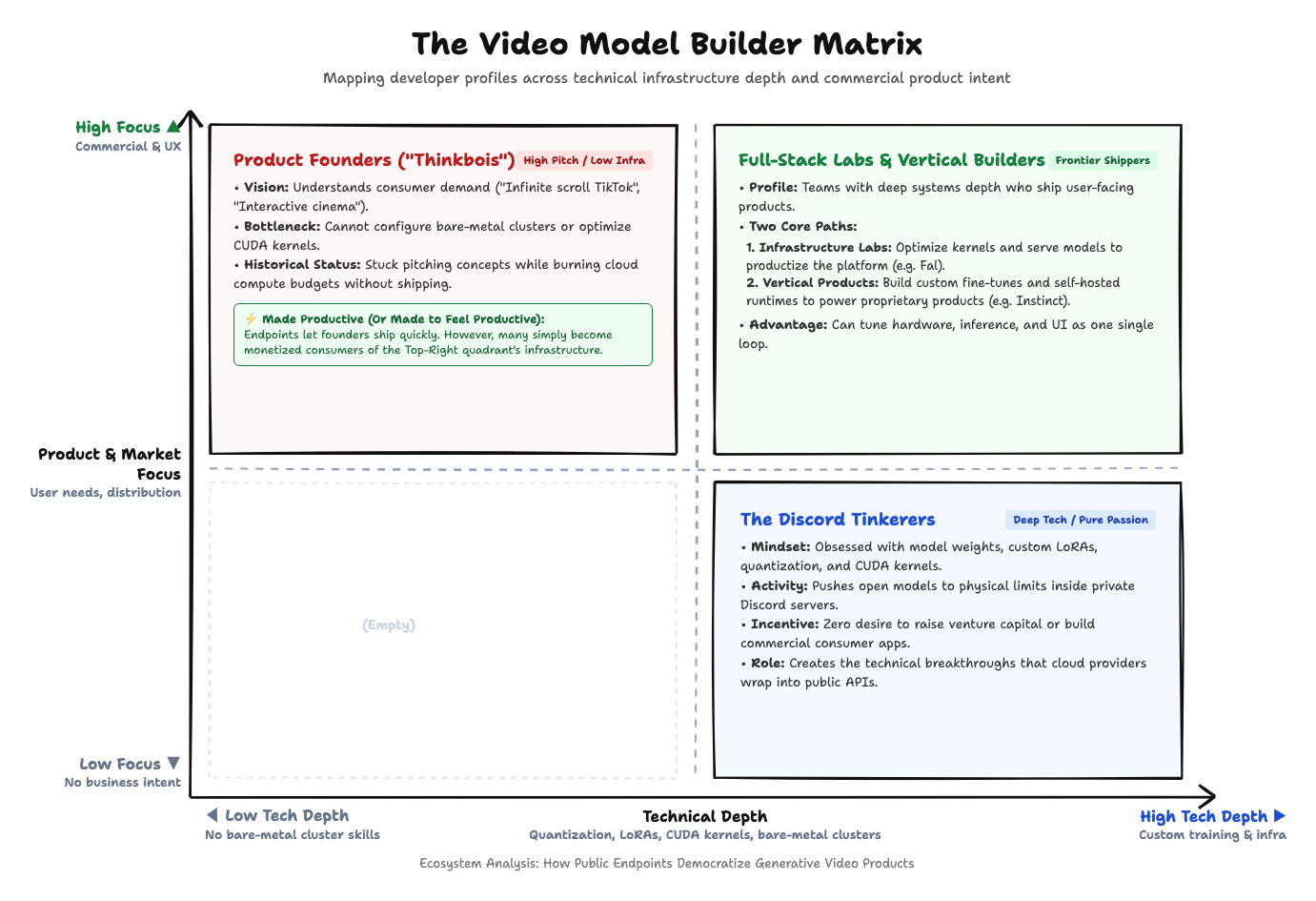
The developer landscape divides across two axes: technical infrastructure depth and commercial product intent.
- Product Founders (“Thinkbois”): They understand consumer demand (“infinite scroll TikTok”, “interactive A24 movie”). But they do not configure bare-metal clusters or write CUDA kernels. Fast API endpoints make this group productive, or at least make them feel productive. In practice, many simply become downstream consumers monetized by the infrastructure platforms in the top-right quadrant.
- Full-Stack Labs & Vertical Builders: Teams that combine deep systems competence with shipping user-facing products. This includes infrastructure platforms that optimize kernels and serve models as products (such as Fal), as well as vertical application companies that deploy custom fine-tunes and self-hosted runtimes to power proprietary products (such as Instinct).
- The Discord Tinkerers: Developers who train custom LoRAs, quantize weights, and benchmark open models inside private communities for the pure obsession of tinkering. They create the technical breakthroughs that cloud providers wrap into public APIs.
Speed as the Capability Unlock
An important truth across all AI models is that a serious improvement in speed is often the unlock itself.
The model does not need to jump in raw visual quality. If it gets significantly faster, it crosses an operational threshold and unlocks an entirely new category.
We saw this dynamic with coding models. Gemini 3.7 Flash might not match the benchmark intelligence of frontier reasoning models on edge cases, but its speed changes how you work. You stay in a tight feedback loop rather than waiting for an overnight batch job.
The Convergence into Hypermedia
This speed threshold is driving three powerful media forms to converge into one: algorithmic social media, linear video, and video games.
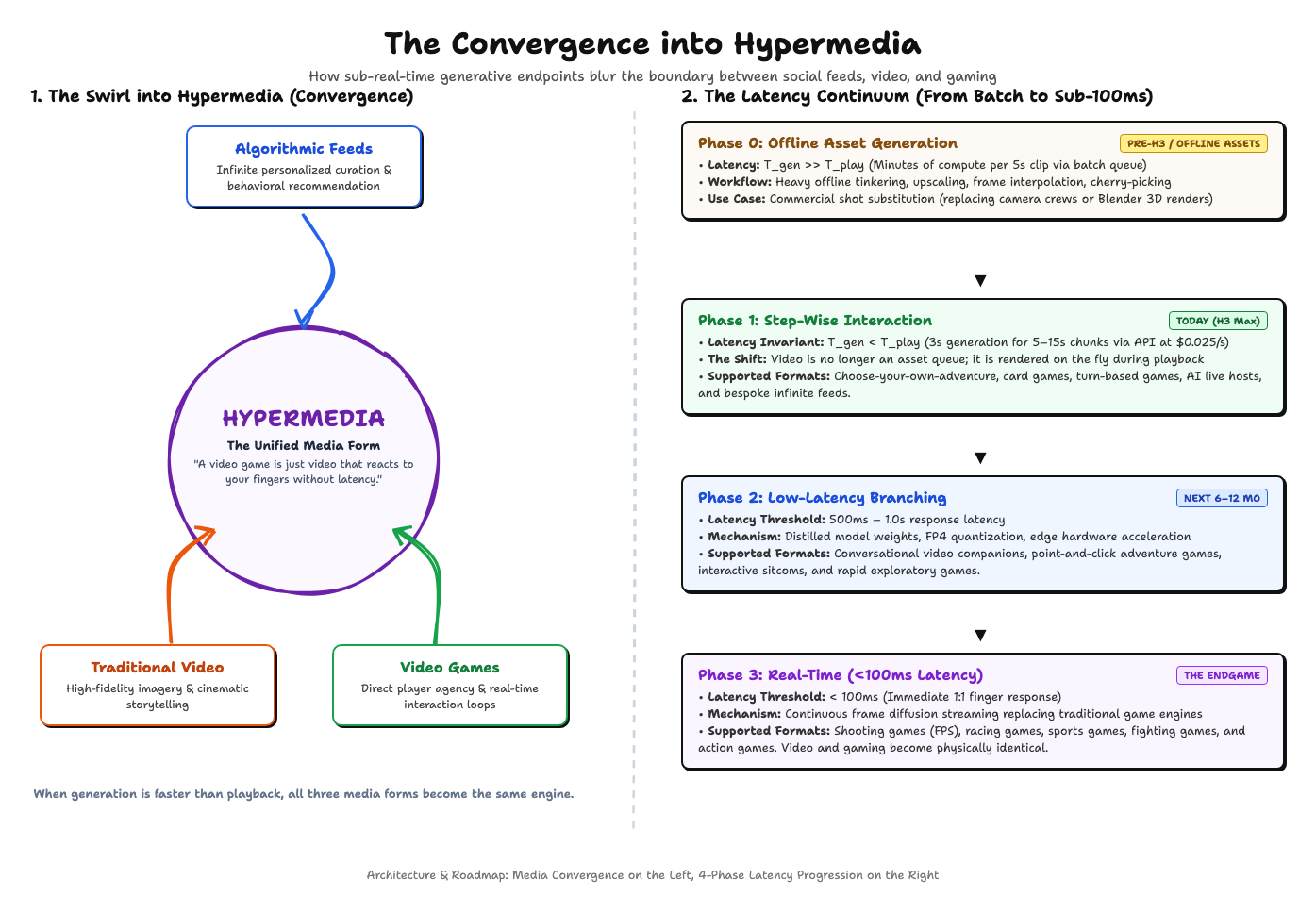
At an architectural level, there is no real boundary between a video game and a video. A video game relies on a game engine, but experientially it is just a stream of video frames. It feels interactive because the video updates in 1:1 correspondence with your controller inputs without noticeable latency.
As generation latency drops, the distinction disappears entirely.
The Latency Roadmap
- Phase 0: Offline Commercial Asset Generation (The Past): Pre-H3 models ran in slow batch queues (T_gen >> T_play). Quality eventually reached commercial viability to substitute for camera crews or 3D Blender renders, but it required heavy offline tinkering, upscaling, frame interpolation, and cherry-picking. Real-time interactivity was zero.
- Phase 1: Step-Wise Interactive Media (Today): With chunk generation under playback duration (3s generation for 5–15s chunks), video shifts from an offline asset queue to a live generative stream. Builders can ship turn-based games, card games, interactive story branching, AI live hosts, and dynamic feeds.
- Phase 2: Low-Latency Branching (Next 6–12 Months): As models are distilled and quantized to FP4, latencies will drop to 500ms–1.0s. This unlocks conversational NPC video companions, interactive sitcoms, and responsive adventure games.
- Phase 3: Sub-100ms Generative Games (The Horizon): When video generation latency drops below 100ms, diffusion models can replace traditional 3D graphics engines entirely. Shooting games (FPS), racing games, sports games, fighting games, and action games merge into a single continuous media format: Hypermedia.
Video Endpoints Are Getting Cheap
Fal released H3 Max Turbo, which is faster, cheaper, and benchmarks with comparable quality.
The pricing is $0.025 per second for 480p output (excluding their 75% launch promotion through September 7). In a few months, that will likely be the standard baseline price for even higher quality output.